AI training is now one of the fastest-growing job categories in tech today, with global demand hitting 281% in a year and cross-border hiring crossing 283%. Generalists roughly earn $15–20 an hour, while experts in law, medicine, and finance command $80–$100 an hour. Just to be clear on what this is, it’s contract work, not a salary. You rate chatbot answers, write prompts, label data, or record your voice, and you are paid only for work that gets approved. Queues dry up without warning, rates change mid-project, and some platforms won’t take you at all because of the country on your passport. Still, it is real money for people who treat it like gig work and sign up to two or three platforms at once. I compared 20 of them against their own published rules and recent public reports from October 2026, then looked at what each one pays, who can actually join, and how painless it is to get paid.
Recommended sites to start training AI
I compared 20 AI Training platforms on pay, country access and how easy they are to cash out. These are the three I would start with.
#1 Mercor
Pays $20-$200 an hour by role, with a median near $75 on open listings. Generalists can get in, but the money is in engineering, finance, law and medicine.
#2 Handshake AI
Pays $40-$125 an hour, set per project and shown before you accept. Open applications are for US-based students and graduates with work authorization, and outside the US it is invite-only.
#3 Prolific
Began as an academic research marketplace and now runs AI evaluation studies. The pay floor is $8 an hour, and AI studies have listed around $19-$30.
Where to start
If you only read one section, read this.
Score Comparison Table: all 20 side by side
Mercor leads at 79 of 100; Remotasks trails at 38
Score out of 100, split into the five scoring categories
Editorial scores, October 2026, based on platform rules and public reports.
20 Best Sites to Make Money by Training AI
Now that you have a brief understanding of what AI training jobs are and a rating of my top 20 picks, let’s dig deeper into each profile.
1. Mercor
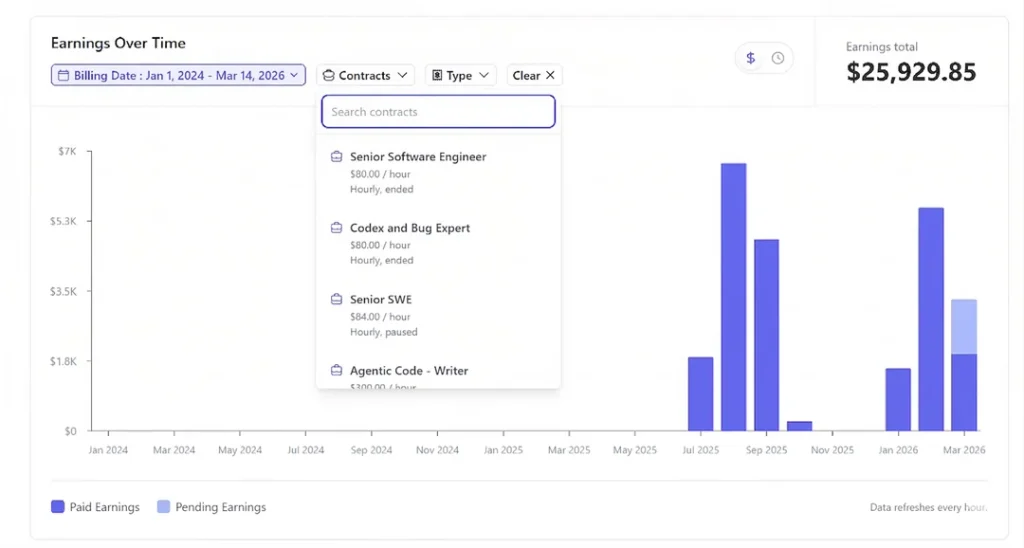
Out of the 20 sites listed here, Mercor pays the best and accepts more countries than you would expect, but you should note that it’s an expert’s market. You apply to a specific listing, sit a recorded AI interview, and your rate is set per role, anywhere from about $20 to $200+ an hour, with a rough estimate nearing $75 on the open listings board. If you are more into generalist work, you can definitely get in, but the money is in engineering, finance, law, medicine, and rare languages.
After the interview comes a one-time Persona ID check, then you’ll link your bank and complete your tax details. EU contractors also sign a W-8BEN form. Stripe Connect covers 130+ countries, and Wise picks up a few more, such as Brazil, the UAE, Nepal, and Turkey, though around 100 countries still can’t be onboarded, so read the supported-countries page before you start. Pay lands weekly through Stripe Express or Wise. Rates and weekly hour caps can change when you are moved to a new project, so never budget around one offer.
⭐ Mercor Key Takeaways
2. Alignerr
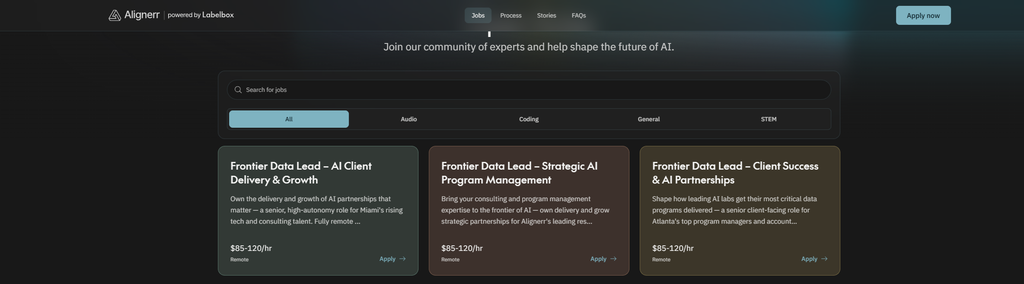
Alignerr is how Labelbox recruits and pays its AI trainers. Generalist task authors earn about $20-50 an hour, while software, finance, and engineering roles earn $60-120. Alignerr is known to reward people with a real profession, a few examples reaching $150 an hour. Labelbox mentions supporting 40+ countries and 75+ languages, though often contested online. Once signed up, you’ll sign a contract and verify your ID. Expect activity tracking on hourly projects. Payment is weekly through Stripe Connect or PayPal, depending on where you live. Note: The pay model matters more than the rate. Some projects pay by tracked hour, others only for tasks that pass review, so a bad batch can mean unpaid work. Ask which model a project uses before you start.
⭐ Alignerr Key Takeaways
3. DataAnnotation
DataAnnotation is loved for predictable rates and quick PayPal cash-outs, though disliked for its strict onboarding criteria. General projects here start at $25-50+, multilingual work at $20+, coding at $40-150+, and STEM or professional work at $40-125+. There is no public country list, though it’s known to accept applicants from the US, UK, Canada, Australia and New Zealand. Once you pass the starter assessment, you upload a government photo ID and a selfie, then request PayPal payouts yourself, which usually arrive within a few days. Note: You get one attempt at the assessment, so take it when most convenient for you. From our sources, the most common complaint is silence, either long gaps with no projects or no explanation after a failed assessment. On the bright side, you can make life-changing income if you take this as a full-time job once accepted.
⭐ DataAnnotation Key Takeaways
4. Mindrift
Mindrift is quite literally known to say yes when others say no. It is the AI trainer platform behind Toloka’s former crowd tasks and accepts applications from nearly everywhere, excluding 17 sanctioned countries and around 35 unsupported territories. The price of that openness is regional pay: reported rates run about $16-40 an hour; open listings show an average rate in the low-to-mid $40s. Once registered, expect to submit your CV, pass an assessment, and verify your ID for specialized projects. Payment goes through Payoneer or PayPal via Tipalti on the 5th and 20th of each month, with a $20 minimum withdrawal on Payoneer, and some tasks pay as soon as they are accepted. Note: early open tasks often pay the least per task, so judge it by the specialized projects, not the first to pop up.
⭐ Mindrift Key Takeaways
5. Handshake AI
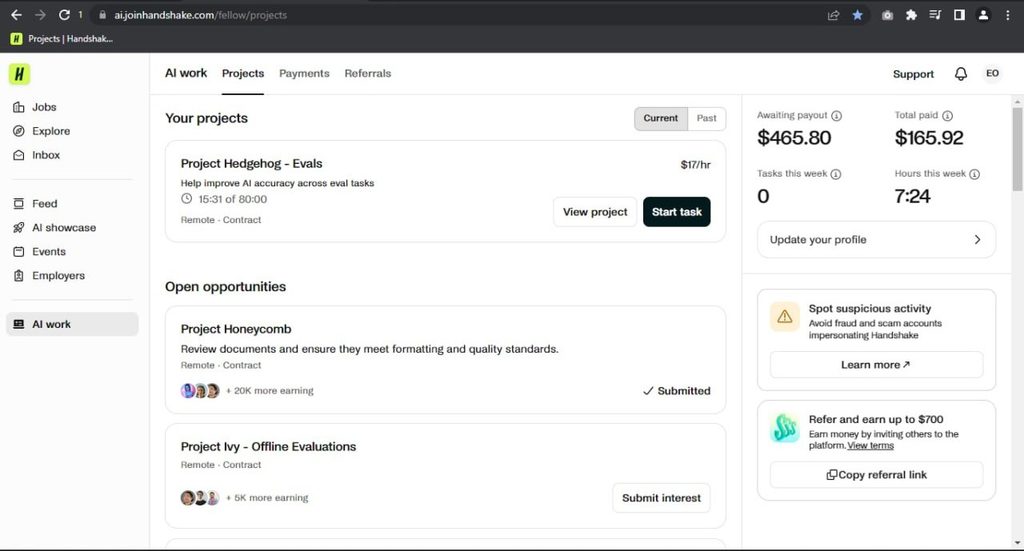
Handshake AI pays strongly for students, graduates, and professionals, provided you are based in the United States, UK, Canada, India, Australia, Europe, or Latin America. The pay revolves around $15 to $125+, depending on the project requirements. If you are in the US, you’ll need US residence with work authorization (F-1 students on CPT or OPT may qualify), and outside the US you can join only by invitation. Verification is a persona identity check plus phone verification, with periodic verification checks. Handshake itself pays through Stripe every Wednesday.
⭐ Handshake AI Key Takeaways
6. Outlier
Outlier is Scale AI’s contributor brand and the default option for most people outside the US, as long as your country is on its list. Generalists earn roughly $15 to $35 an hour and credentialed experts $50-150, depending on your location. Reports showed a US specialist role at $35 an hour beside language work in India at $8. The published list of places you may work from took effect July 15, 2026, and sources count anywhere from 60 to 116 countries depending on the date, notably excluding Kenya, Nigeria, and Ghana. Verification here means government ID and location checks, with a strict ban on VPNs, proxies, or any other location-masking software. Payouts are weekly via PayPal, AirTM, or bank transfer.
⭐ Outlier Key Takeaways

7. micro1
Different from the previous six AI training sites, Micro1 vets professionals with a 20-40 minute interview run by an AI recruiter called Zara, then offers a contract if you pass, though certification does not guarantee placement. No general rate is actually published as of date. Projects usually pay hourly, per task, or as a flat fee, and unapproved tasks can go unpaid. Its country exclusion list is short, with about 20 places, including Russia, Iran, China, and Ukraine, which makes it one of the more open options for experts. KYC is mandatory and handled through Deel, and pay arrives in US dollars twice a month.
⭐ micro1 Key Takeaways
8. Terac
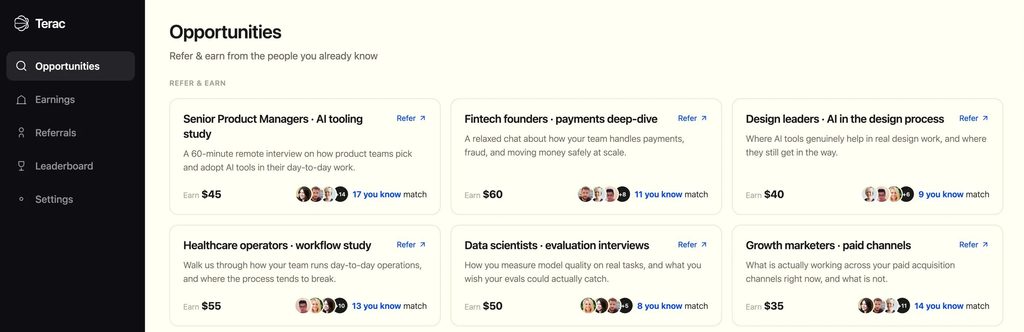
Terac is built for verified professionals such as lawyers, engineers, clinicians, and accountants. Interestingly, the best work is one-off paid interviews and expert evaluations rather than hourly grinding. Interviews and studies are listed at $100-350, and expert AI evaluation at $30-$100+, but entry-level tasks can pay as little as $2-5 an hour. Terac operates in 100+ countries, most reporting a positive payout process. Terac verification is one of the heaviest. You are required to submit your legal name, do an SMS phone check, connect your professional profiles, provide a government ID, and complete an AI screening conversation. For payments, Terac offers PayPal to almost all approved countries, with extra options in some countries, and the minimum cash-out is $10 with a $2,000 cap per transaction.
⭐ Terac Key Takeaways
9. Remo Experts (REX)
Remo Experts, also called REX, is praised for its professional treatment towards contributors: onboarding time and weekly meetings are paid, and the pay floor doesn’t collapse for lower-income countries. It advertises a $ 25-an-hour minimum on production work, though each project sets its own rate by complexity, skill, region, and accuracy. The community spans 50+ countries, and applicants outside the US are accepted unless a project has regional limits. When onboarding, you take a one-time 15-20 minute entry exam, then complete a persona identity verification. Payment is monthly, through Stripe, Payoneer, or Wise.
⭐ RemoExperts Key Takeaways
10. Prolific
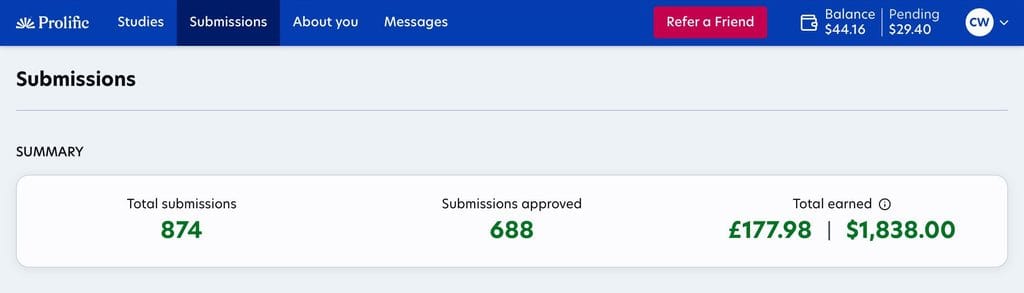
Prolific is believably the most respectable place to start. It began as an academic research marketplace and now runs well-paid AI evaluation studies on the same platform. The pay floor is fixed at $8 (£6) an hour, with about $12 on average. Studies tagged AI training have listed around $19-20 an hour, and language-expert roles go up to $30. Prolific covers about 40 countries and 80+ languages, and the rules are strict and direct: one account, your verifiable name, and your actual residing country. To complete your KYC, you’ll need to upload a photo ID, and your PayPal name must match your Prolific name and ID exactly. Payment is through PayPal only, with instant cash-out after your first four payments. Note: VPNs or an expired ID will fail verification, and you are self-employed, so declare your earnings.
⭐ Prolific Key Takeaways
11. CrowdGen by Appen
CrowdGen is the widest net of the 20 and the lowest-paid of the serious options. It replaced Appen Connect in September 2024 and states working with contributors in 200+ countries. Appen pay rates work per judgment, aiming slightly above the local minimum wage, so plan on roughly $5-20 an hour, and most projects ask you to pass an assessment prior to work. After a profile verification review, payment options include PayPal (fully verified account), Payoneer, Airtm, SWIFT or local bank transfer. Payouts are monthly, with hours submitted early in the month and payment around the 14th of the next. If you’re payment method is Payoneer, it can take about $3 per transaction.
⭐ CrowdGen Key Takeaways
12. TELUS Digital AI Community
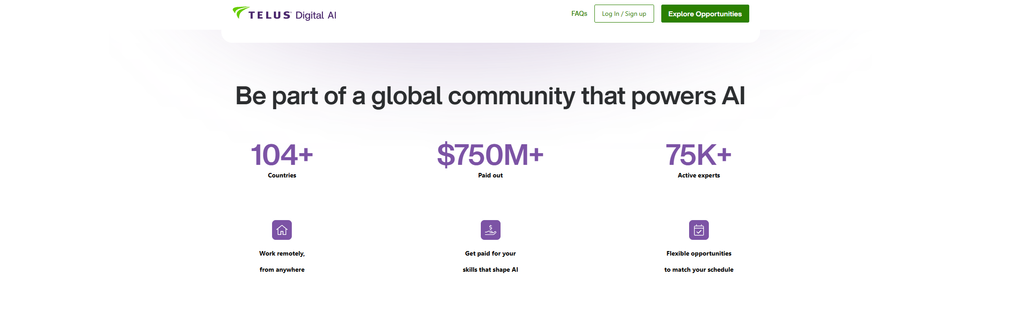
TELUS Digital is a community of over a million contributors doing data collection, rating, translation, and localization work. Roles are posted per country and language, so what you see depends on where you live and what you speak, literally. Pay runs $1-65 an hour with an average rate around $10, and subject-matter experts such as bioinformaticians sit at the top. It operates in 100+ countries role by role, and some roles carry residency rules: a US evaluator role, for example, needs three consecutive years of US residence. Verification and payment both vary by role, with one participant allowed per household, so confirm both in your contract. Note: read the compensation range on the role’s detail page, instead of trusting the list card.
⭐ TELUS Digital Key Takeaways
13. Workbolt AI
Workbolt AI suits you if you have a clear speaking voice in a language labs are training for. Roles are conversation partners and transcribers, paid $10-40 an hour with a $20 average. Availability runs role by role from US-only to open-language roles. ID verification is reported at under ten minutes.
⭐ Workbolt AI Key Takeaways
14. JumpTask
JumpTask isn’t quite an AI training job. It better fits the micro-earning category where AI tasks are a small slice next to offers, social tasks, bonus codes and referrals, so expect cents to a few dollars per task. It’s open worldwide with light verification, and its strength is flexibility. You can withdraw from $0.50 by crypto, gift cards, PayPal, Visa, Mastercard, Wise, Revolut, Venmo, bank transfer or Skrill. Note: Only use it for small change, not as a main income.
⭐ JumpTask Key Takeaways
15. Postwork
Postwork is a freelance marketplace for AI model training gigs with a refreshingly simple payout structure: bank transfer through Stripe, with no minimum and no fee. There are no published pay rates, so check individual job listings for the real numbers. It is described as open worldwide, but since it pays through Stripe bank transfer, your country must be one Stripe supported list, and you’ll need to verify your identity through Stripe when setting up payouts. Note: pay is set per gig, so never accept a job without seeing the rate in writing.
⭐ Postwork Key Takeaways
16. Hive Micro
Hive Micro offers simple micro-jobs, many closer to data entry than AI training, with the occasional AI task. Pay is low per task and verification is light, so it suits pocket money seekers and people who want zero assessments. It is advertised as global but blocks some countries. Payment is via PayPal or Bitcoin every Tuesday once you reach $10.
⭐ Hive Micro Key Takeaways
17. AfterQuery
AfterQuery is an applied research lab that turns expert work into training material such as fine-tuning examples, reasoning traces, grading rubrics, and computer-use demonstrations. The pay range is not verified. Your country is limited by Stripe because the bank country must match your registration, and identity verification also runs through Stripe. Afterquerry pays on a weekly schedule, Fridays, via Stripe bank transfer only, with no minimum. Note: your first payout carries a 7-day hold.
⭐ AfterQuery Key Takeaways
18. Welocalize
Welocalize offers scheduled rater work for people who speak a language AI labs want checked. Supply is steady for in-demand language pairs. Hours are bounded, and each role names its own country and language. The pay has often been reported as a weak point; recent listings showing $10 an hour for Swedish, $7 for German, $6 for Spanish, $5 for French and $5 for Russian in Kazakhstan. Onboarding is a contract, and payment terms are not clearly published in the listings.
⭐ Welocalize Key Takeaways
19. Contracted AI
With Contracted AI, you film first-person videos of everyday chores such as cooking, cleaning, and gardening, which down the line become training data. It is open globally with light verification. However, pay rates, minimums, and the payout schedule are unclear, and payment goes to your Whop account. Note: If you have personal restrictions to showing your day-to-day life, this might not be a great fit.
⭐ Contracted AI Key Takeaways
20. Remotasks
Remotasks is still legitimate and still run by Scale AI, but it is the shakiest of this list for new sign-ups. Reported pay is about $5-20 an hour, with training courses mandatory before seeing any paid tasks, after which many people find an empty queue. Remotasks claims 90+ eligible countries but has no published list. It shut down in Kenya, Nigeria, and Pakistan in 2024. Existing contractors in Poland, India, Thailand, and Vietnam kept access, and a sign-up test from Brazil in August 2026 was turned away and redirected to Outlier. Identity checks happen at onboarding, and reports differ on payout: PayPal and AirTM in one account, Payoneer or Wise in others. Note: confirm the payout method in your own dashboard before spending time training.
⭐ Remotasks Key Takeaways
Also worth a look
SME Careers (global, 100+ eligible countries, reported around $15 an hour on an entry project), RWS TrainAI (rater and evaluator roles, mostly country-specific), and Toloka, whose tasks have moved to Mindrift.
Three things that decide if you actually get paid
Check all three before you spend hours on an assessment.
Country: Two separate questions hide in here. Where does the platform recruit, and where can its payment partner actually fulfill your payment? Most of the AI training sites we’ve gone through list the places you may work from, and ask for ID and a phone number from your country of residence. VPNs, Proxies and Remote desktop tools are highly forbidden, and buying or borrowing an account registered in another country breaks those rules and can get the account permanently closed.
ID check: Platforms verify you because their clients want one real person per account. Expect a government ID and selfie (Persona handles this for Mercor, Handshake AI and REX), a phone check, and sometimes a tax form. Use the same legal name on your ID, the platform, and your payout account, and finish every verification step before you start earning. Make sure to shoot the ID in good light, and upload it only inside the platform’s own flow, never over WhatsApp or email.
Payout route: This is where good platforms can still go wrong for you. A PayPal account existing in your country is not the same as it receiving freelance payments there. Stripe needs a bank in a supported country, and first payouts can be held for 7 days. Payoneer can carry minimums and fees, such as the $20 minimum on Mindrift or about $3 per transaction on CrowdGen, without forgetting that account reviews can delay pay. Wise needs your currency and country to be supported, and Deel delays payment when documents are missing. AirTM has ID-verification holds and monthly withdrawal caps of around $8,000, lower in some countries. Whop, crypto, and gift cards carry fees and unclear schedules, which is fine for small sums.
If you live in Africa or South Asia
Based on published rules in October 2026, Outlier does not list Kenya, Nigeria, or Ghana, though it does list Egypt, South Africa, and India. Remotasks closed in Kenya, Nigeria and Pakistan in 2024, Handshake AI is invite-only outside the US, and DataAnnotation is reported to take only a handful of countries. So the platforms most worth trying first are Mindrift, CrowdGen, TELUS Digital, Micro1 (which publishes a short exclusion list), REX, and Terac. Before any assessment, confirm that Payoneer, Stripe, Wise, or PayPal work efficiently in your country.
FAQs
Are AI training jobs legit?
Yes, the platforms here are real businesses that pay for approved work. What isn’t guaranteed is the work itself: queues empty, projects end, and rates change. Judge a platform by whether it pays, not by whether it keeps you busy.
Yes, the platforms here are real businesses that pay for approved work. What isn’t guaranteed is the work itself: queues empty, projects end, and rates change. Judge a platform by whether it pays, not by whether it keeps you busy.
How much can I realistically earn?
Think in tiers. General labelling and rating usually pays about $10-25 an hour, skilled or coding work $25-50, and credentialed experts $75-200. Hours matter as much as rates: $50 an hour for five hours a week is $250, and some weeks it is zero.
Think in tiers. General labelling and rating usually pays about $10-25 an hour, skilled or coding work $25-50, and credentialed experts $75-200. Hours matter as much as rates: $50 an hour for five hours a week is $250, and some weeks it is zero.
Do I need a degree or experience?
Not for the entry tier. Prolific, CrowdGen, TELUS and Mindrift take people without credentials. Mercor, Handshake AI, Alignerr’s top roles and Terac pay for proven expertise, and they will ask for it.
Not for the entry tier. Prolific, CrowdGen, TELUS and Mindrift take people without credentials. Mercor, Handshake AI, Alignerr’s top roles and Terac pay for proven expertise, and they will ask for it.
Can I work from any country?
No, and this is the biggest filter. Outlier, DataAnnotation, Handshake AI and Remotasks restrict by country; Mindrift, CrowdGen, TELUS, micro1 and REX are the widest. Check the platform’s rules and your payout rail first.
No, and this is the biggest filter. Outlier, DataAnnotation, Handshake AI and Remotasks restrict by country; Mindrift, CrowdGen, TELUS, micro1 and REX are the widest. Check the platform’s rules and your payout rail first.
Why was I rejected or ignored after an assessment?
Usually one of three things: the platform has enough people in your location or skill area, you missed a quality bar, or your ID or location didn’t check out. Several assessments allow one attempt, so read the instructions twice. Using AI to pass an assessment can get you rejected or banned.
Usually one of three things: the platform has enough people in your location or skill area, you missed a quality bar, or your ID or location didn’t check out. Several assessments allow one attempt, so read the instructions twice. Using AI to pass an assessment can get you rejected or banned.
Do I have to pay to join?
Never. A real platform doesn’t charge for access, training, an “unlock” or a withdrawal. Be wary of WhatsApp recruiters, emails from free mail addresses, and anyone selling you an account.
Never. A real platform doesn’t charge for access, training, an “unlock” or a withdrawal. Be wary of WhatsApp recruiters, emails from free mail addresses, and anyone selling you an account.
Why do they want my ID?
Clients require one real person per account, and verification keeps duplicate and fraudulent accounts out of training data. It is normal, but upload only through the official flow, and use your legal name everywhere.
Clients require one real person per account, and verification keeps duplicate and fraudulent accounts out of training data. It is normal, but upload only through the official flow, and use your legal name everywhere.
How fast will I be paid?
Mercor, Alignerr and Outlier pay weekly. DataAnnotation and Prolific pay to PayPal on request. Mindrift pays on the 5th and 20th, micro1 twice a month, and CrowdGen and REX monthly. The first payout is often the slowest because of verification and holds.
Mercor, Alignerr and Outlier pay weekly. DataAnnotation and Prolific pay to PayPal on request. Mindrift pays on the 5th and 20th, micro1 twice a month, and CrowdGen and REX monthly. The first payout is often the slowest because of verification and holds.
What about taxes?
Most of these arrangements are independent contracting. Mercor, for example, doesn’t withhold tax and tells contractors to report their own income, and Prolific describes participants as self-employed. Keep records of what you earn and ask a local tax professional what applies to you.
Most of these arrangements are independent contracting. Mercor, for example, doesn’t withhold tax and tells contractors to report their own income, and Prolific describes participants as self-employed. Keep records of what you earn and ask a local tax professional what applies to you.
Which two should I start with?
If you have a degree or profession and can use them: Mercor and Alignerr. If you are outside the US and UK with no credentials: Mindrift and CrowdGen. Add Prolific for studies you can do at any time. Then watch which one actually sends work.
If you have a degree or profession and can use them: Mercor and Alignerr. If you are outside the US and UK with no credentials: Mindrift and CrowdGen. Add Prolific for studies you can do at any time. Then watch which one actually sends work.